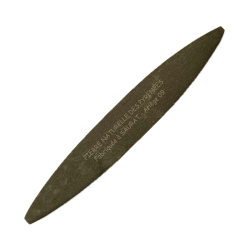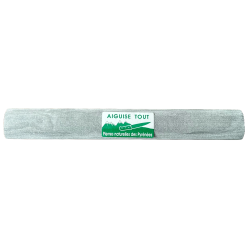
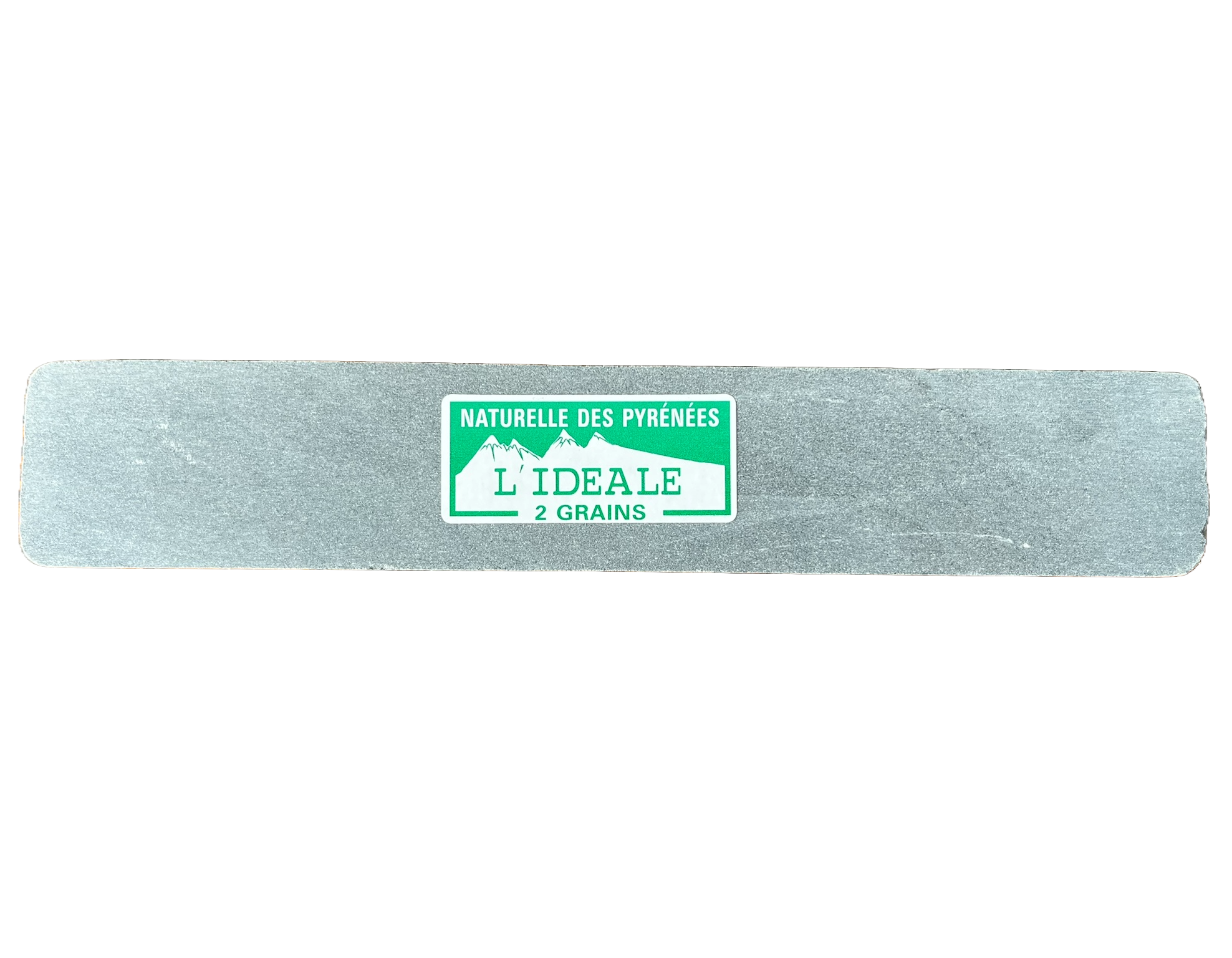


The "L'idéale" stone has a rectangular section and lives up to its name: perfect for sharpening knives, it is also easy to use on garden tools. Its two faces, coarse and fine, and its manufacture in the Pyrenees, in Saurat, make it a complete stone.
 A question?
The team is at your disposal for all your questions.
 Delivery
Thanks to our carriers, we deliver everywhere in France and Europe.
 Secure payment
Visa, Mastercard...
The "L'idéale" stone has a rectangular section and lives up to its name: perfect for sharpening knives, it is also easy to use on garden tools. Its handcrafted design and versatile dimensions (200 x 35 mm, 15 mm thick) make it an ideal choice for both uses.
Cut from a "hard" grade natural schistose sandstone, it has two faces: a coarse face and a fine face. This lets you start from scratch on a dull edge, then refine it until you get a mirror edge.
Like all our Pyrenees stones, it is cut from a natural schistose sandstone quarried with respect for the environment in Saurat, in Ariège. It can be used wet with water for gentle sharpening, or dry for a more abrasive effect.
Sold individually.
| Stone | Dimensions (mm) | Weight | Grade | Main use |
|---|---|---|---|---|
| Knife stone 120 x 25 x 12 | 120 x 25 x 12 | 104 g | Medium-hard, smooth (≈ 1000 grit) | Small knives, pocket stone |
| Carpenter's stone 120 x 60 x 14 | 120 x 60 x 14 | 280 g | Medium-hard, smooth (≈ 1000 grit) | Woodworking tools, pointed tools |
| "L'idéale" 2 grits 20 cm | 200 x 35 x 15 | 240 g | Hard, 2 faces (coarse and fine) | Knives and garden tools, 2 faces |
| "Aiguise Tout" 230 x 30 | 230 x 30 x 15 | 240 g | Hard | Knives and garden tools, hand-held stone |
| Knife stone 300 x 50 x 20 | 300 x 50 x 20 | 847 g | Medium-hard, smooth (≈ 1000 grit) | Long blades, harvest knives |
| Knife stone 240 x 60 x 35 | 240 x 60 x 35 | 1.425 kg | Medium-hard, smooth (≈ 1000 grit) | Flat sharpening, large knives, straight tools |
The coarse face is used to restore a dull edge by removing more metal. The fine face then refines the edge until you get a mirror finish. One stone therefore takes you from rough sharpening to finishing.
For knives and garden tools, the hand-held "Aiguise Tout" stone and the two-sided "L'idéale" stone are the most versatile. For flat sharpening of large knives, the very stable 240 x 60 x 35 stone and the very long 300 x 50 x 20 stone are the most comfortable. The 120 x 25 x 12 stone fits in a pocket, and the carpenter's stone is made for workbench hand tools.
It is not compulsory, but it is recommended: wet with water, the stone sharpens gently and does not heat up. Used dry, it gives a more abrasive effect. Soak it in water before use for more pleasant work.
They complement each other. A file removes more metal and is used to reshape a dull or chipped edge, especially on forged tools in hardened steel. The stone then refines the edge, removes the burr and gives a clean cutting edge.
Rinse it with clean water to remove residue, remove embedded particles with a soft brush, wash it with mild soap if needed, then rinse thoroughly and let it dry completely before storing.
Data sheet
You might also like
The "L'idéale" stone has a rectangular section and lives up to its name: perfect for sharpening knives, it is also easy to use on garden tools. Its two faces, coarse and fine, and its manufacture in the Pyrenees, in Saurat, make it a complete stone.