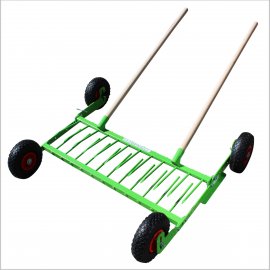




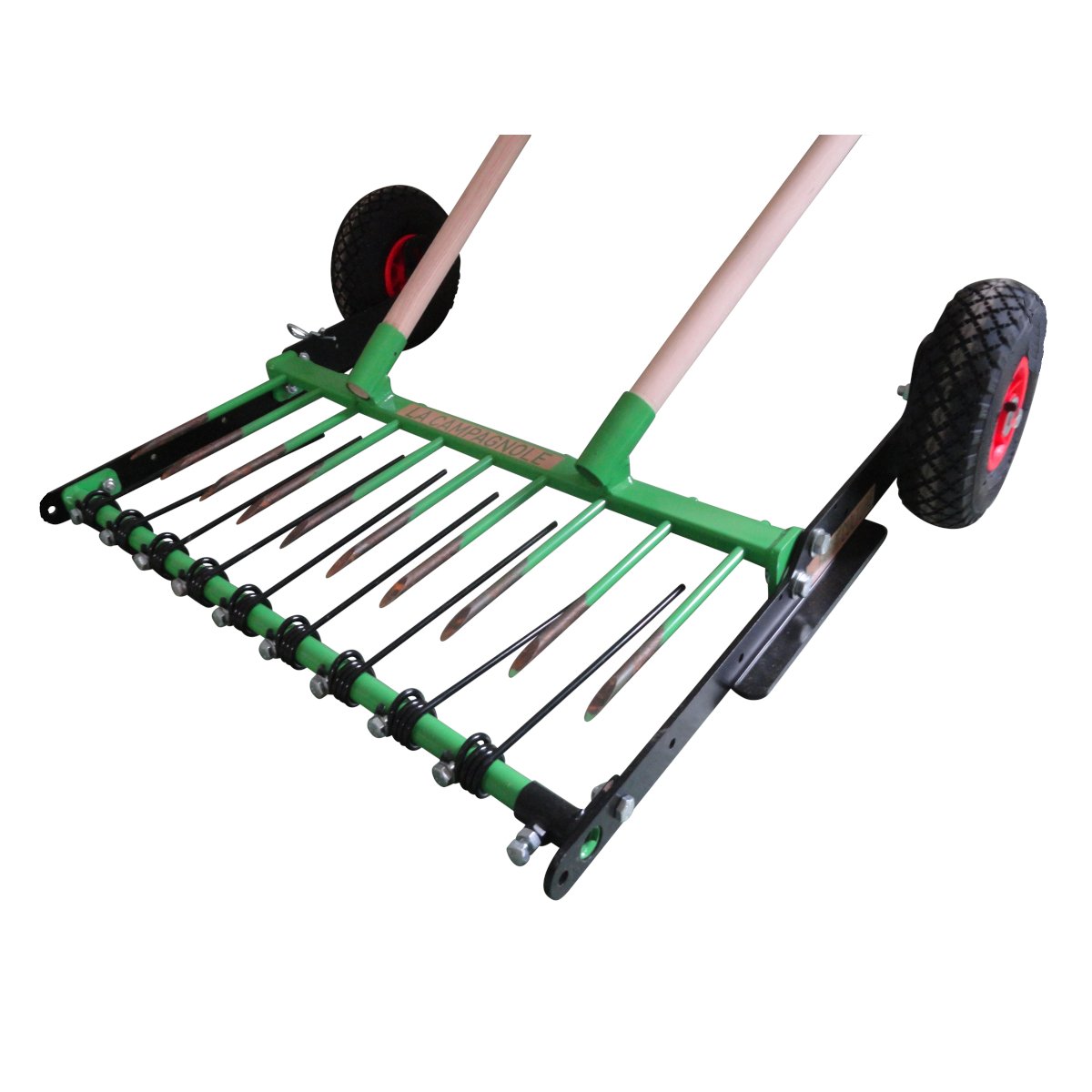


La Campagnole® Maraîcher with spring counter-teeth is the professional soil-working tool for large plots with light, sandy or stony soils. 80 cm wide, pneumatic Ø 26 cm wheels, flexible counter-teeth that ejects stones and roots. No engine, made in Aveyron, France.
 A question?
The team is at your disposal for all your questions.
 Delivery
Thanks to our carriers, we deliver everywhere in France and Europe.
 Secure payment
Visa, Mastercard...
La Campagnole® Maraîcher with spring counter-teeth is designed for large plots with light, sandy or stony soils: where fixed counter-teeth are better suited to heavy soils, the springs eject stones and roots and return to position without jamming.
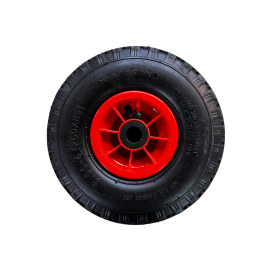
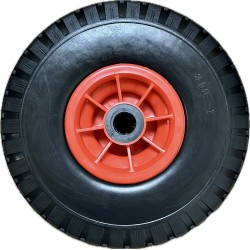
Like all Campagnole® models, this tool has pneumatic Ø 26 cm wheels so it never needs to be lifted, ensuring better stability on wide market garden beds. This reduces strain on the back and allows an upright posture throughout the work. Its 8 hardened steel tines penetrate to 24 cm depth and aerate the soil without inverting it, preserving soil structure and soil life. Handmade in Aveyron, lifetime guarantee on all welds.
BENEFITS
✅ 80 cm wide — covers 60% more surface per pass than the 50 cm model ;
✅ Spring counter-teeth — eject stones and roots without jamming or breaking ;
✅ Ideal for light, sandy and stony soils on large plots ;
✅ Pneumatic Ø 26 cm wheels — optimum stability and flotation on market garden beds ;
✅ No engine — complete silence, no fuel, no emissions ;
✅ Does not invert the soil — structure and soil life preserved ;
✅ Lifetime weld guarantee ;
✅ Made in Aveyron, France — artisanal and professional quality.
HOW TO USE
MAINTENANCE
FAQ
What is the difference between the Maraîcher 80 CDF and the 80 CDR?
Same tool, same width. The only difference is the counter-tooth type: fixed (CDF) for heavy, clay soils; spring (CDR) for light, sandy or stony soils — the springs eject stones and roots without jamming. On compost-amended or naturally light soils, the CDR is the better choice.
Can the Maraîcher CDR replace a rotary tiller on a smallholding?
On well-maintained plots, yes — especially in intensive market gardening on permanent beds. It does not invert the soil, which is desirable in agroecology and permaculture. It remains a manual tool: beyond 2,000 m² on initial preparation of very compacted ground, a motorised pass may be needed.
Data sheet
Specific References
You might also like
La Campagnole® Maraîcher with spring counter-teeth is the professional soil-working tool for large plots with light, sandy or stony soils. 80 cm wide, pneumatic Ø 26 cm wheels, flexible counter-teeth that ejects stones and roots. No engine, made in Aveyron, France.