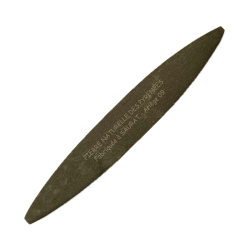
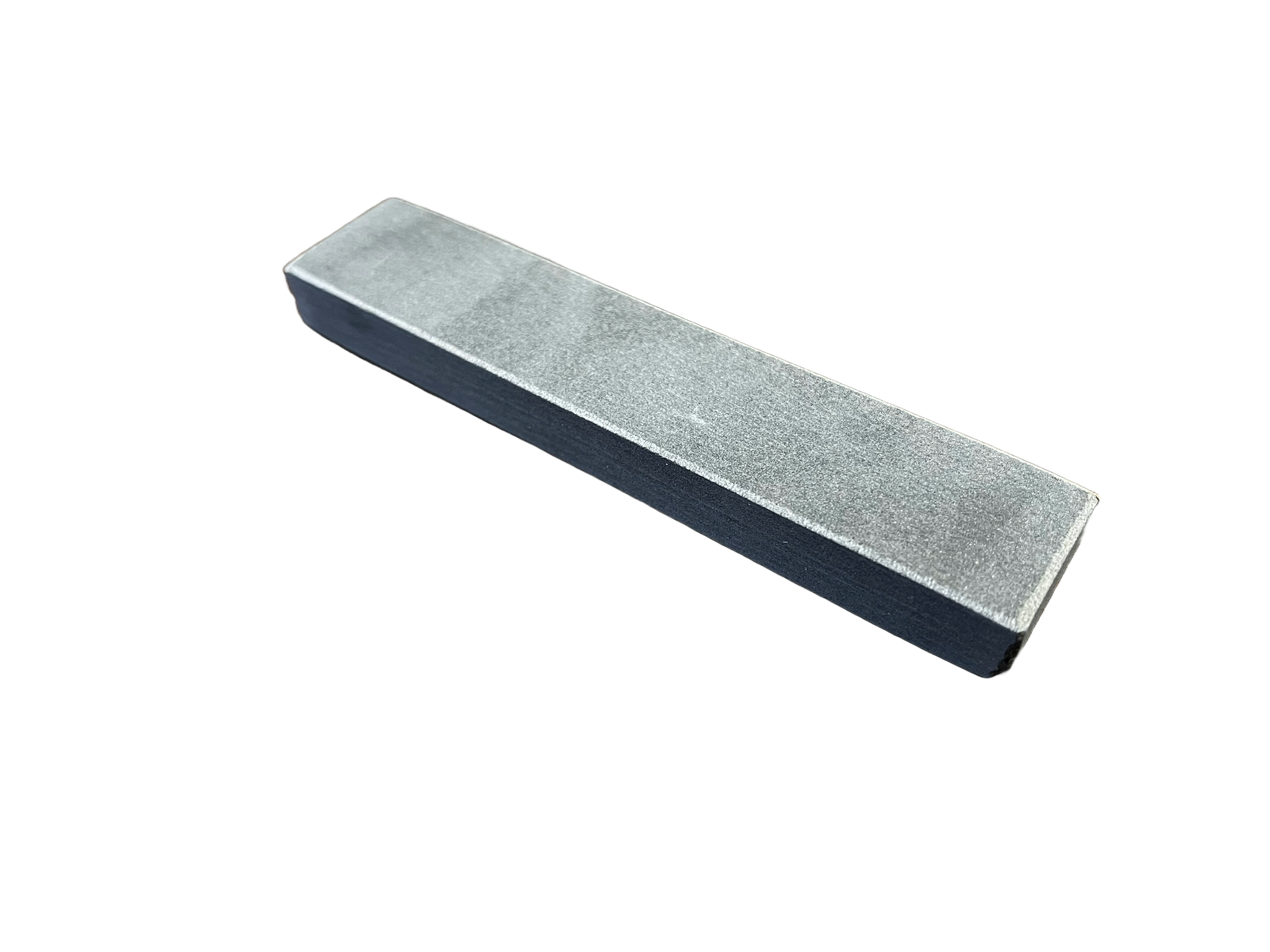


A compact knife sharpening stone, perfect for slipping into a backpack or pocket to sharpen garden tools as well. Made in the Pyrenees, in Saurat.
 A question?
The team is at your disposal for all your questions.
 Delivery
Thanks to our carriers, we deliver everywhere in France and Europe.
 Secure payment
Visa, Mastercard...
This compact knife stone (120 x 25 mm, 12 mm thick, 104 g) is the ideal choice for small knives or for taking everywhere: it slips into a backpack or a pocket to sharpen garden tools too. Cut from a "medium-hard" grade natural schistose sandstone with a smooth finish, it offers a fineness equivalent to a 1000 grit.
Like all our Pyrenees stones, it is cut from a natural schistose sandstone quarried with respect for the environment in Saurat, in Ariège. It can be used wet with water for gentle sharpening, or dry for a more abrasive effect.
Sold individually.
| Stone | Dimensions (mm) | Weight | Grade | Main use |
|---|---|---|---|---|
| Knife stone 120 x 25 x 12 | 120 x 25 x 12 | 104 g | Medium-hard, smooth (≈ 1000 grit) | Small knives, pocket stone |
| Carpenter's stone 120 x 60 x 14 | 120 x 60 x 14 | 280 g | Medium-hard, smooth (≈ 1000 grit) | Woodworking tools, pointed tools |
| "L'idéale" 2 grits 20 cm | 200 x 35 x 15 | 240 g | Hard, 2 faces (coarse and fine) | Knives and garden tools, 2 faces |
| "Aiguise Tout" 230 x 30 | 230 x 30 x 15 | 240 g | Hard | Knives and garden tools, hand-held stone |
| Knife stone 300 x 50 x 20 | 300 x 50 x 20 | 847 g | Medium-hard, smooth (≈ 1000 grit) | Long blades, harvest knives |
| Knife stone 240 x 60 x 35 | 240 x 60 x 35 | 1.425 kg | Medium-hard, smooth (≈ 1000 grit) | Flat sharpening, large knives, straight tools |
The stone is natural and has no standard grit number: this equivalence means its fineness is comparable to that of a 1000 grit stone. It is a maintenance and finishing grit, which refines the edge rather than reshaping a badly damaged one.
For knives and garden tools, the hand-held "Aiguise Tout" stone and the two-sided "L'idéale" stone are the most versatile. For flat sharpening of large knives, the very stable 240 x 60 x 35 stone and the very long 300 x 50 x 20 stone are the most comfortable. The 120 x 25 x 12 stone fits in a pocket, and the carpenter's stone is made for workbench hand tools.
It is not compulsory, but it is recommended: wet with water, the stone sharpens gently and does not heat up. Used dry, it gives a more abrasive effect. Soak it in water before use for more pleasant work.
They complement each other. A file removes more metal and is used to reshape a dull or chipped edge, especially on forged tools in hardened steel. The stone then refines the edge, removes the burr and gives a clean cutting edge.
Rinse it with clean water to remove residue, remove embedded particles with a soft brush, wash it with mild soap if needed, then rinse thoroughly and let it dry completely before storing.
Data sheet
You might also like
A compact knife sharpening stone, perfect for slipping into a backpack or pocket to sharpen garden tools as well. Made in the Pyrenees, in Saurat.