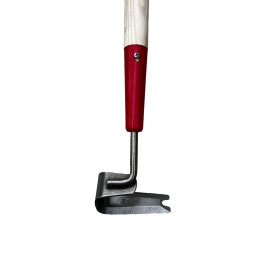




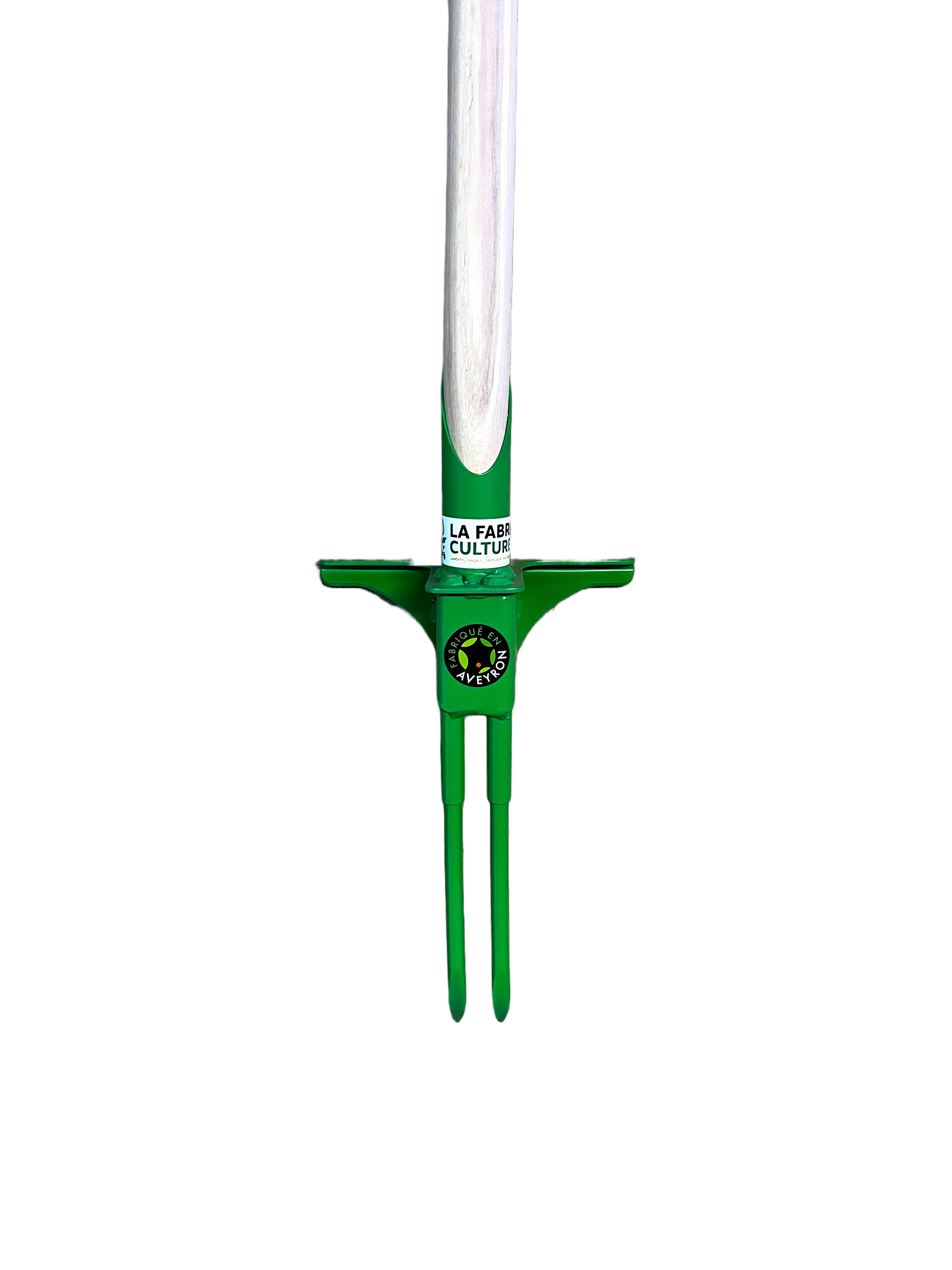


La Fabriculture's Arrache Rumex is the ecological alternative to herbicides for cleanly extracting tap-rooted plants: dock, thistles, dandelions, as well as carrots, leeks, parsnips and young shrubs. Mechanowelded structure inspired by traditional forged tools, 120 cm wooden handle, available in two sizes (21 cm or 30 cm tines). Made in Aveyron, France.
 A question?
The team is at your disposal for all your questions.
 Delivery
Thanks to our carriers, we deliver everywhere in France and Europe.
 Secure payment
Visa, Mastercard...
Dock, thistles, dandelions: these deep tap-rooted plants come back relentlessly if you simply cut their foliage. The only effective and lasting solution is to extract the whole root — without herbicides, without turning the soil, without damaging surrounding crops. That is precisely what La Fabriculture's Arrache Rumex was designed for.
This ancient tool, originally forged, has been brought up to date with a mechanowelded structure that makes it robust, light and easy to handle. The principle is simple: drive the two tines either side of the root by pressing your foot on the footrest, then pull the handle towards you — the root comes out whole, without breaking. The action is performed standing up, back straight, without kneeling.
It is available in two sizes to suit the depth of roots: the standard version (21 cm tines) suits common weeds and moderately deep root vegetables. The long version (30 cm tines) reaches deeper roots or more resistant subjects — established dock plants, thistles in compacted soil, parsnips and carrots grown in open ground, and young shrubs. Made in Moyrazès, Aveyron.
BENEFITS
✅ Alternative to herbicides — extracts the whole root to prevent regrowth ;
✅ Used standing up — back straight, no kneeling, posture preserved ;
✅ 2 sizes available — 21 cm tines (standard) or 30 cm (long) depending on root depth ;
✅ Mechanowelded structure — inspired by traditional forged tools, robust and lightweight ;
✅ Powder-coated steel — corrosion resistance, long service life ;
✅ 120 cm wooden handle ;
✅ Versatile — weeds (dock, thistle, dandelion), young shrubs and root vegetables (carrot, leek, parsnip) ;
✅ Respects soil structure — no turning, soil life preserved ;
✅ Made in Aveyron — artisanal French design and manufacture.
HOW TO USE
MAINTENANCE
FAQ
What is the difference between the standard (21 cm) and the long (30 cm) version?
The standard version (21 cm tines) suits common weeds — dandelions, young dock, young thistles — and moderately deep root vegetables. The long version (30 cm tines) is recommended for established dock plants, thistles in compacted soil, carrots and parsnips grown in open ground, or any subject whose root exceeds 20 cm depth.
Does the Arrache Rumex work on all soil types?
Yes, but its effectiveness varies with soil moisture. On slightly moist soil the root comes out whole with minimal effort. On very dry and compacted soil the root may snap — a light pre-watering solves the problem. On very light, sandy soil the tool works perfectly with no prior preparation.
Can the Arrache Rumex be used to harvest vegetables?
Yes — it extracts carrots, leeks, parsnips and beetroot without snapping them or damaging neighbouring vegetables. The action is identical to weeding: tines either side of the vegetable, foot on the footrest, pull towards you.
Why is it necessary to extract the whole root rather than just cutting the plant?
Dock, thistle and dandelion are tap-rooted plants capable of regenerating a whole new plant from a root fragment left in the soil. Cutting or hoeing the surface only delays regrowth. Only complete root extraction permanently eliminates the plant — without herbicides, without turning the soil.
Is the Arrache Rumex suitable for professional market gardening?
Yes. It is a light, fast and ergonomic tool that allows large areas to be worked standing up without excessive fatigue. It is used by market gardeners, horticulturists and farmers in organic agriculture and permaculture as an alternative to herbicides. For large areas with a high density of weeds, it combines effectively with a hoe or a Campagnole® for soil preparation.
Data sheet
Specific References
You might also like
La Fabriculture's Arrache Rumex is the ecological alternative to herbicides for cleanly extracting tap-rooted plants: dock, thistles, dandelions, as well as carrots, leeks, parsnips and young shrubs. Mechanowelded structure inspired by traditional forged tools, 120 cm wooden handle, available in two sizes (21 cm or 30 cm tines). Made in Aveyron, France.