



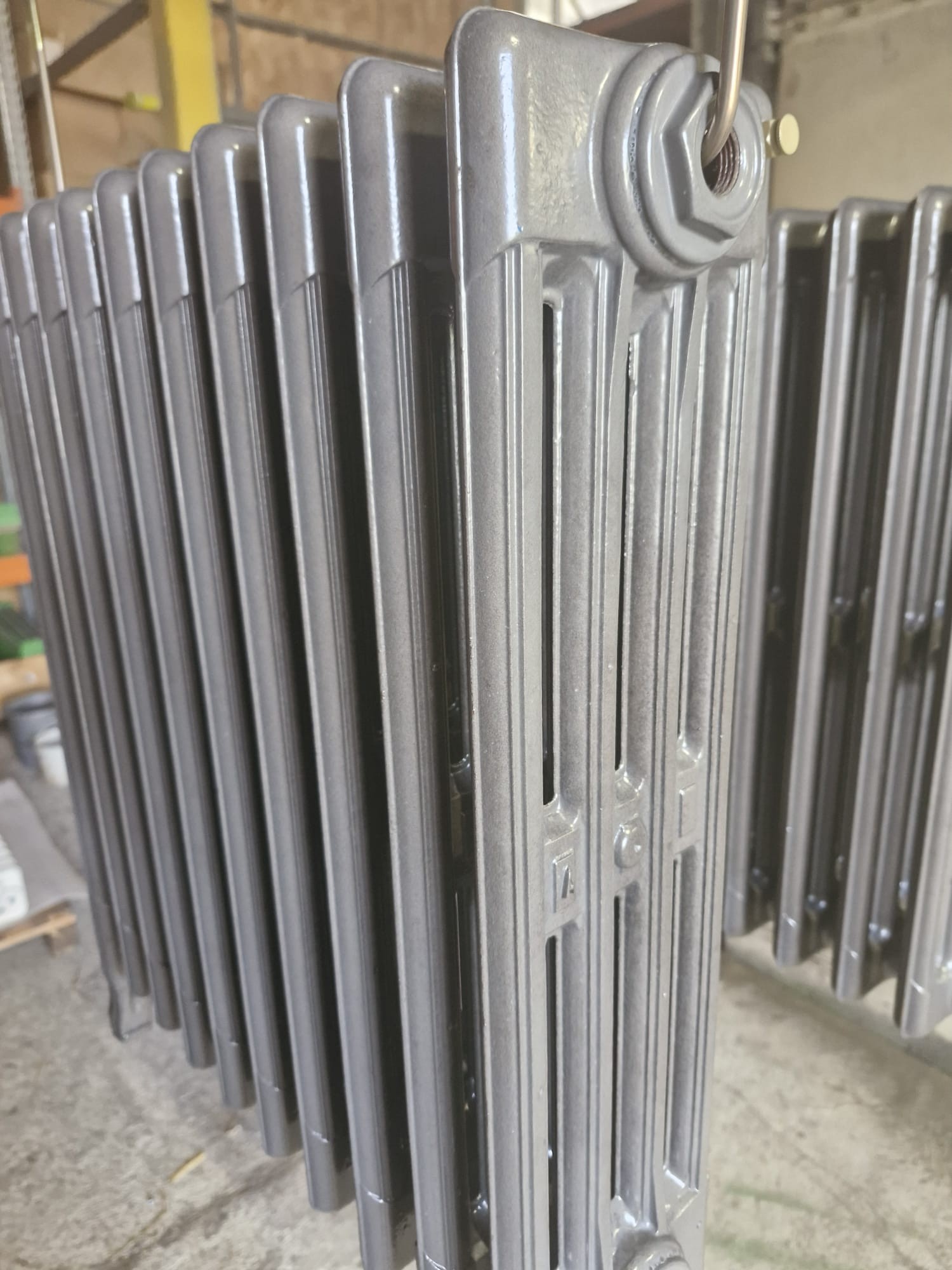


Our workshop in Moyrazès, in the Aveyron region of France, restores cast iron, steel and aluminium radiators: caustic soda bath stripping, sandblasting, anti-corrosion primer and powder coating in the RAL colour of your choice. Drop your radiators off at the workshop or have them collected on a pallet by our carrier, anywhere in France and Europe.
 A question?
The team is at your disposal for all your questions.
 Delivery
Thanks to our carriers, we deliver everywhere in France and Europe.
 Secure payment
Visa, Mastercard...
An old cast iron radiator often heats just as well as a new one: it is the flaking or yellowed paint and the rust that make it unusable. Rather than replacing it, our workshop in Moyrazès strips it back to bare metal and gives it a powder-coated finish, far more durable than paint applied with a brush or spray can. You keep the original character of your radiators, with a clean, long-lasting finish.
The caustic soda bath thoroughly removes old layers of paint, grease and dirt, right into the smallest recesses of cast iron sections.
Sandblasting removes every trace of rust and leaves a slightly rough surface. This is the step that allows the coating to adhere properly over time.
A primer protects the bare metal against oxidation before the finishing coat.
An epoxy or polyester powder is applied and then cured in an oven. Unlike conventional paint, it withstands the heat of the radiator without yellowing, blistering or giving off odours. You choose the colour from the RAL chart, in a gloss, satin or matt finish.
Over the years, sludge and oxides build up inside radiators and reduce their output. On request, we add power flushing to the quote, which takes about 15 minutes per radiator on average. Your radiator is then restored inside and out.
Most of our customers drop their radiators off directly at our workshop in Moyrazès, in the Aveyron. If you live further away, you prepare your radiators on a pallet and our carrier collects it from your address, anywhere in France and Europe, then delivers it back to you once the restoration is complete. Return transport is priced in the quote according to the number of pallets: for example, 20 steel radiators fit on 3 pallets.
If a radiator arrives damaged, we photograph it on receipt and let you know. Once the work is finished, we send you photos of your restored radiators.
Allow on average 3 weeks of work in the workshop, plus transport time, which varies with distance and the time of year.
Sandblasting may reveal cracks or porosity in the cast iron that were invisible before treatment. During oven curing, the seals expand and may cause a leak when the radiator is refilled: in this case, it is advisable to leave the radiator full of water for a while. We recommend having the radiators pressure-tested by your installer when they are fitted. La Fabriculture does not guarantee that radiators are watertight and accepts no liability for leaks or breakage found during or after treatment, nor for rust spots on leaking or cracked welds.
Yes. A cast iron radiator that is sound inside can look like new again after stripping, sandblasting and powder coating. You keep its original style and its thermal mass, which is often greater than that of a modern steel radiator.
Paint applied with a brush or spray can does not hold up well on a radiator that heats up: it yellows, flakes and can give off an odour. Powder coating is a powder paint cured in an oven, on metal that has been stripped, sandblasted and primed. It is much more resistant to heat and knocks.
Yes. You prepare your radiators on a pallet and our carrier collects it from your address, anywhere in France and Europe, then delivers it back once the radiators are restored. Return transport is priced in the quote.
Allow on average 3 weeks in the workshop, plus transport time, which depends on distance and the time of year.
We send you photos of your radiators once the work is finished.
Drain the radiators, remove all fittings (valves, bleed valves, plugs) and take off any plastic parts. If your radiators still contain sludge, ask for the power flushing option.
It is possible: sandblasting can reveal existing cracks in the cast iron, and oven curing puts stress on the seals. Leave the radiator full of water for a while after fitting and have it pressure-tested by your installer.
Any colour from the RAL chart, in a gloss, satin or matt finish. The colour is confirmed with you before work begins.
The price depends on the number of radiators, their size, their material, the options chosen (such as power flushing) and transport. Send us photos and dimensions to receive a free quote.
You might also like
Our workshop in Moyrazès, in the Aveyron region of France, restores cast iron, steel and aluminium radiators: caustic soda bath stripping, sandblasting, anti-corrosion primer and powder coating in the RAL colour of your choice. Drop your radiators off at the workshop or have them collected on a pallet by our carrier, anywhere in France and Europe.


