




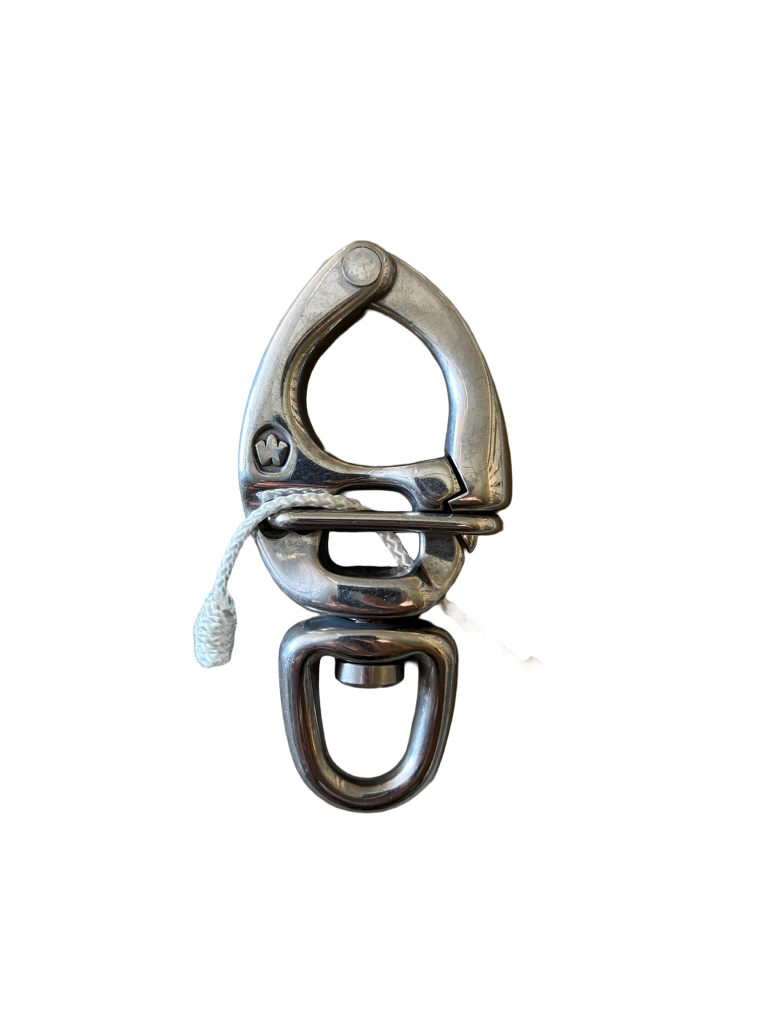


The Wichard ref. 2676 is a load-release snap hook forged in HR 17.4 PH stainless steel, with swivel eye. Working load 2,400 kg, breaking load 4,200 kg — designed and made in France. Release is achieved by pulling on the lanyard, even under load.
Sold individually
 A question?
The team is at your disposal for all your questions.
 Delivery
Thanks to our carriers, we deliver everywhere in France and Europe.
 Secure payment
Visa, Mastercard...
In animal traction, the safety of the handler and the animal sometimes depends on the ability to release the hitch in a fraction of a second. In the event of danger — a fall, a blockage, an animal caught in an obstacle — every second counts. We use the Wichard 2676 precisely for this situation: by pulling on the lanyard, the hitch is released immediately, even under load. The animal is free in a single movement.
Forged in HR 17.4 PH stainless steel — a high-strength stainless alloy used where standard grades (316L) are not sufficient — it delivers very high working and breaking loads for its size: 2,400 kg working load and 4,200 kg breaking load. The integrated swivel eye allows free rotation of the snap hook on its axis, eliminating twisting and parasitic stress during changes of direction by the animal or the towed implement.
Designed and made in France by Wichard, the reference manufacturer in high-strength stainless hardware since 1922.
BENEFITS
✅ Instant safety release — frees the hitch in one movement by pulling the lanyard, even under load ;
✅ Active safety — essential in animal traction to protect handler and animal in an emergency ;
✅ Forged HR 17.4 PH stainless — superior mechanical strength over standard 316L stainless ;
✅ Working load 2,400 kg / breaking load 4,200 kg — rated for heavy agricultural loads ;
✅ Swivel eye — free rotation, zero twisting during manoeuvres ;
✅ WLL lifting 840 kg (safety factor 5) ;
✅ Designed and made in France — Wichard, world reference since 1922.
HOW TO USE
MAINTENANCE
FAQ
Why use a load-release snap hook in animal traction?
In animal traction, an animal that becomes stuck, falls or bolts can be seriously injured if the hitch cannot be released quickly. A standard snap hook cannot open under tension — you would first need to unload the line, which is impossible in an emergency. The Wichard 2676 releases in a single movement on the lanyard, even if the animal is pulling with full force. It is an active safety device.
Where should the snap hook be positioned on the hitch?
The snap hook should be placed at a point on the traction line that is easily accessible to the handler in working position — typically between the trace and the towed implement, or between the collar and the swingletree. The lanyard must remain permanently within reach. If in doubt about positioning, consult an animal traction specialist.
What is a load-release snap hook?
A standard snap hook can only be opened when unloaded — any tension on the body prevents opening. A load-release snap hook has a lanyard-triggered release mechanism that allows the fitting to be freed even under load. It is essential in all situations where it is not possible to unload the system before detaching it.
What is HR 17.4 PH stainless steel and how does it compare to 316L?
HR 17.4 PH is a precipitation-hardening stainless steel with significantly higher tensile and fatigue strength than austenitic 316L stainless. For the same dimensions, a HR 17.4 PH component supports far higher loads than an equivalent 316L part. Wichard uses it for all its high-performance hardware.
What is the difference between working load, breaking load and WLL?
The breaking load (4,200 kg) is the force at which the part fails in laboratory testing. The working load (2,400 kg) is the maximum load recommended for normal use. The WLL — Working Load Limit (840 kg) — applies specifically to industrial lifting applications, with a safety factor of 5 against the breaking load.
Data sheet
The Wichard ref. 2676 is a load-release snap hook forged in HR 17.4 PH stainless steel, with swivel eye. Working load 2,400 kg, breaking load 4,200 kg — designed and made in France. Release is achieved by pulling on the lanyard, even under load.
Sold individually